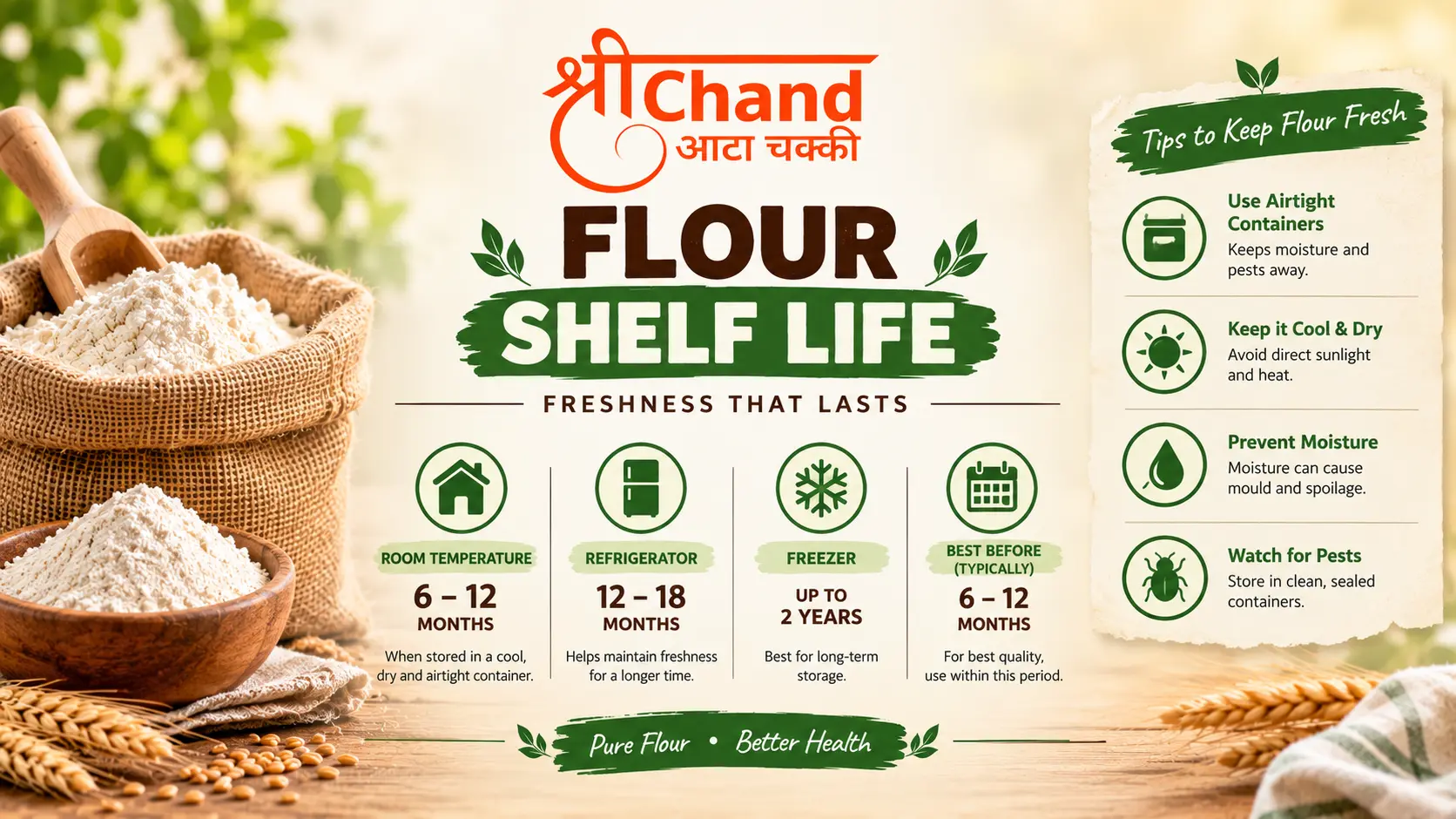
Whole wheat atta lasts about 4 to 6 weeks at peak freshness in a sealed pantry container, up to 4 months refrigerated, and up to 8 months frozen. Maida lasts longer at every stage due to its lower oil content, typically 2 to 3 months in the pantry and up to a year frozen. Millet flours like bajra, jowar and ragi, and besan, generally sit between the two, with pantry life of around 3 to 4 weeks. These figures assume airtight storage away from heat and humidity, which is the single biggest factor affecting how close you get to the upper end of any of these ranges.
Flour shelf life by storage method
This table gives a practical range for how long each flour type stays at good quality under three common storage conditions. Ranges reflect proper storage, meaning an airtight container kept away from heat, light and moisture. For the habits that help you reach the upper end of these ranges, see how to store flour properly.
| Flour type | Pantry (airtight, cool) | Refrigerated (sealed) | Frozen (sealed) |
|---|---|---|---|
| Whole wheat atta | 4 to 6 weeks | 3 to 4 months | 6 to 8 months |
| Maida (refined flour) | 8 to 12 weeks | 5 to 6 months | 10 to 12 months |
| Multigrain atta | 3 to 5 weeks | 3 to 4 months | 6 to 8 months |
| Besan (chana flour) | 8 to 10 weeks | 4 to 5 months | 8 to 10 months |
| Bajra flour | 3 to 4 weeks | 2 to 3 months | 5 to 6 months |
| Jowar flour | 3 to 4 weeks | 2 to 3 months | 5 to 6 months |
| Ragi flour | 4 to 6 weeks | 3 to 4 months | 6 to 8 months |
| Soya flour | 2 to 3 months | 4 to 5 months | 8 to 10 months |
| Rice flour | 2 to 3 months | 4 to 6 months | 8 to 10 months |
These numbers are general guidance based on typical composition and common storage conditions, not exact laboratory measurements, since actual shelf life varies by brand, freshness at purchase, local climate and how consistently a container stays sealed.
Why shelf life differs so much between flour types
The main factor separating these numbers is natural oil content. Flours that retain more of the grain's natural oils, particularly whole wheat, multigrain blends and millet flours like bajra and jowar, lose freshness faster because those oils oxidise with exposure to air and heat. Maida, besan, soya flour and rice flour generally have lower oil content relative to their structure, or in the case of besan and soya, different fat composition that is somewhat more stable, which is why they tend to last longer in all three storage conditions. For the full explanation of what drives this difference, see does flour expire, which covers the oxidation process in more detail.
Pantry storage: what affects the range
Pantry shelf life varies the most of the three storage conditions in this table, since room temperature and humidity swing widely by season and location across India. A kitchen in a hot, humid coastal city during monsoon season will generally see flour degrade faster than a cooler, drier climate, even with identical container choices. Within the ranges given above, expect to land closer to the lower end during summer and monsoon months, and closer to the upper end during cooler, drier months.
Freshness at the time of purchase also matters significantly. Freshly milled stone ground, or chakki, atta starts with more of its natural oils intact than flour that has already spent weeks or months in storage before reaching you, which means the shelf life clock effectively started earlier than the purchase date suggests. Our guide to chakki atta benefits and fresh atta versus packaged atta explains why checking the milling date matters more than most labels make clear.
Refrigerated storage: when it is worth it
Refrigeration roughly doubles to triples the pantry shelf life for most flour types, since the cooler temperature significantly slows oxidation. This is particularly useful for flours you do not use daily, such as a specialty millet flour kept on hand for occasional cooking, or for extending a larger bulk purchase without the full commitment of freezing.
The trade-off is convenience and moisture risk. Flour needs to be in a genuinely airtight container before refrigeration, since the fridge environment carries more ambient moisture than a dry pantry shelf, and condensation on a poorly sealed container can introduce the exact moisture problem you are trying to avoid.
Frozen storage: the longest option
Freezing offers the longest shelf life extension of the three methods, useful for large bulk purchases, less frequently used specialty flours, or simply maximising how long flour stays at good quality. As with refrigeration, an airtight, well sealed container or bag is essential, both to prevent moisture and to stop the flour from absorbing odours from other frozen food.
One practical note: frozen flour should be brought to room temperature before using it in dough. Cold flour can behave differently during kneading, affecting water absorption and the texture of the final dough, so planning ahead by moving flour to the counter or fridge a few hours before cooking generally gives better results than using it straight from the freezer.
How to extend flour shelf life regardless of type
A handful of habits apply across every flour type in the table above and make a meaningful difference regardless of which one you are storing.
- Always use an airtight container, transferring flour out of its original packaging if that packaging does not seal well.
- Store away from heat sources, particularly the stove, oven and any spot that receives direct sunlight through a window.
- Keep the container dry, using a dedicated dry spoon or scoop rather than wet utensils.
- Buy in quantities matched to your actual usage, rather than stocking up far beyond what you will use within the flour's realistic pantry shelf life.
- Check milling dates when buying, particularly for whole wheat and chakki atta, since freshness at purchase sets the starting point for everything that follows.
Frequently asked questions
How long does whole wheat flour last? Whole wheat flour typically stays at its best for 4 to 6 weeks in an airtight pantry container, extending to 3 to 4 months refrigerated and 6 to 8 months frozen, assuming proper sealed storage throughout.
Does maida last longer than whole wheat flour? Yes, generally. Maida has the bran and germ removed, which lowers its natural oil content and makes it more stable over time, typically lasting 8 to 12 weeks in the pantry compared to 4 to 6 weeks for whole wheat flour.
How long can flour be stored in the freezer? Most flour types can be frozen for 6 to 12 months in a well sealed, airtight container, with maida and besan on the longer end of that range and whole wheat and millet flours on the shorter end due to their higher natural oil content.
Does millet flour have a shorter shelf life than wheat flour? Generally yes. Millet flours like bajra and jowar tend to have a pantry shelf life of around 3 to 4 weeks, somewhat shorter than whole wheat flour, due to their own natural oil content and typically finer, more exposed surface area.
Should I refrigerate flour I use every day? It is usually unnecessary for flour used within its normal pantry shelf life window, since refrigeration mainly helps when storage time extends well beyond typical daily or weekly use. Proper airtight pantry storage is generally sufficient for flour used regularly.
Does stone ground atta have a shorter shelf life than regular atta? Often slightly, yes, since stone ground flour tends to retain more of the natural oils from the wheat germ, which are the compounds most responsible for freshness loss over time. This is part of why freshly milled stone ground atta is best used within a reasonably short window.
The bottom line
Flour shelf life is not one number, it is a range that depends on the type of flour, how it is stored, and the climate it is stored in. Whole wheat and millet flours are the most time sensitive due to their natural oil content, while maida, besan and rice flour tend to hold up longer. Matching your storage method, pantry, fridge or freezer, to how often you actually use a particular flour is the most practical way to get the most out of every bag you buy.
For the complete explanation of why flour loses freshness over time and how to judge whether a particular bag is still good, read does flour expire next, or start with the fundamentals in how to store flour properly.